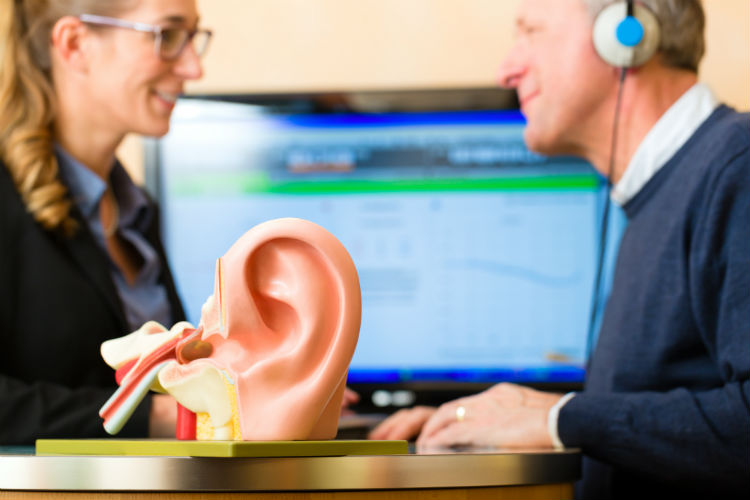

Behind-the-ear hearing aids, in-the-ear hearing aids, completely in the canal hearing aids, binaural hearing aids...and the list goes on. With so many types and hundreds of brands to choose from, what is a senior to do? First and foremost, don't go it alone. Too often, seniors are wooed by a catchy ad or a pushy salesman and wind up with an expensive hearing aid that they shove in a drawer and never use. Work with a qualified audiologist who can conduct a thorough hearing evaluation, determine the type and degree of hearing loss and recommend the appropriate hearing aid, says Dr. Phillip L. Wilson, Au.D., Head of Audiology at Callier Center for Communication Disorders, University of Texas at Dallas.
Types of Hearing Tests
The first thing the audiologist will do is to perform some basic hearing tests, examples of these are below.
Pure tone air conduction audiometry
Patients listen to a range of beeps and whistles (called pure tones) and indicate when they can hear them, by pressing a button or raising their hand. The softest sounds they can hear (hearing thresholds) are then marked on a graph called an audiogram.
Pure tone bone conduction audiometry
This test helps determine where in the ear the hearing problem lies. If in the middle ear, the hearing loss can usually be treated medically. But inner ear hearing loss means the sensory cells are not working properly, and that problem is permanent.
Speech audiometry
Patients are asked to repeat words and sentences in quiet and in noise to help the audiologist understand the practical affect of the hearing loss.
Tympanogram
A test of how well the middle ear system is functioning and how well the eardrum can move.
Questions to Ask
After conducting the tests and isolating the hearing problem, if a hearing aid is the right solution, an audiologist should perform a "lifestyle needs analysis" to determine the type of hearing aid that will work best. Some questions the doctor should ask are:
- How active are you?
- Do you have trouble communicating in noisy places?
- Do you live alone? In an apartment? In a large home?
- Do you talk on the telephone a lot? Watch TV often?
- Do you regularly go out to eat at restaurants?
- Do you have trouble hearing certain family members such as women or children?
- Do you have trouble hearing at religious services, at lectures and at movies?
Hearing Aid Features to Look For
Hearing aid technology is constantly improving, and new products are being introduced all the time. To understand what you need, you first must know how a hearing aid works.
A hearing aid has three basic parts: a microphone, amplifier, and speaker. The hearing aid receives sound through a microphone, which converts the sound waves to electrical signals and sends them to an amplifier. The amplifier increases the power of the signals and then sends them to the ear through a speaker. The hearing aid can be "programmed" on a computer to customize the amplification specifically for your hearing loss.
Here are some of the newest advances in hearing aid technology that you can discuss with your audiologist:
"Open fit" aids
A common complaint among people with hearing aids that fit into their ear is that they hear distractions, such as an echo when they speak; or hearing themselves chew. A new class of hearing aids addresses this issue. Called "open fit" aids, these hearing aids sit behind the ear, with only a wire and tiny loudspeaker going into the ear.
Digital feedback reduction
New hearing aids have good feedback reduction, to reduce or eliminate another common hearing aid complaint: whistling noises.
Digital noise reduction
Using complex algorithms, this feature is making hearing aids "smarter" and able to tell the difference between speech and background noise.
Directional microphones
The directional microphone allows the user to focus on whoever is directly in front with reduced interference from conversations behind and to the sides.
Automatically adaptive
With this technology, the hearing aid changes the way it works when the user walks from one place to another. The hearing aid detects sounds exceeding a certain loudness level, and then self-adjusts to reduce the amplification. For example, in a quiet place, volume level will increase. In a noisy environment, directional mics will kick in as well as noise reduction features.
Bluetooth compatible
The user doesn't have to hold the cell phone up to their ear – which alleviates the feedback some people hear when they answer the phone. When a call comes in, it rings through the hearing aid itself, instead of ringing from the phone. To answer, the wearer simply presses a button.
Take Time to Adapt to a New Hearing Aid
Even after selecting the right hearing aid, don't expect to adapt immediately. Wilson says it often takes a month or more for patients to get used to their new device.
Often, people who are using a hearing aid for the first time will be startled at how loud the world is. Sounds may seem loud and disturbing. Suddenly, the refrigerator makes a roar, the newspaper rattles, even the turn signal in the car becomes disruptive.
When you get a hearing aid, wear it all day, every day. If you wears it only sporadically, you will never get used to the volume of new sounds, and the brain will be confused. It takes at least several weeks for the brain to put those new sounds into perspective.
Be patient when you get a new hearing aid. It requires time to adjust to hearing aids. Your listening skills should improve gradually as you become accustomed to amplification.
30-Day Hearing Aid Trial Period
The FDA requires that manufacturers provide a 30 day trial period for all hearing aids, so take advantage of it. Be sure to use the hearing aid for more than a few days – especially since there's no risk involved. It can be returned for up to 30 days. Being an effective "matchmaker" does take time. But it's time well spent.